

 Search
What We Learned at Fispal Tecnologia Brazil 2026
Five Retail Trends We Took Home from Latin America's Largest Food Technology Exhibition
Every year, Fispal Tecnologia brings together thousands of professionals across the food processing, packaging, and retail industries. While the exhibition is often known for showcasing new equipment and technologies, the greatest value isn't found in individual machines—it's found in the conversations.
At Fispal Tecnologia Brazil 2026, our team had the opportunity to meet retailers, distributors, food processors, and industry partners from across Latin America. Beyond product demonstrations, one thing became increasingly clear: the retail food industry is evolving faster than ever.
Consumer expectations are changing. Retailers are under pressure to improve efficiency while maintaining food safety and product quality. At the same time, labor shortages and rising operating costs are encouraging businesses to rethink how fresh food is weighed, packaged, and presented.
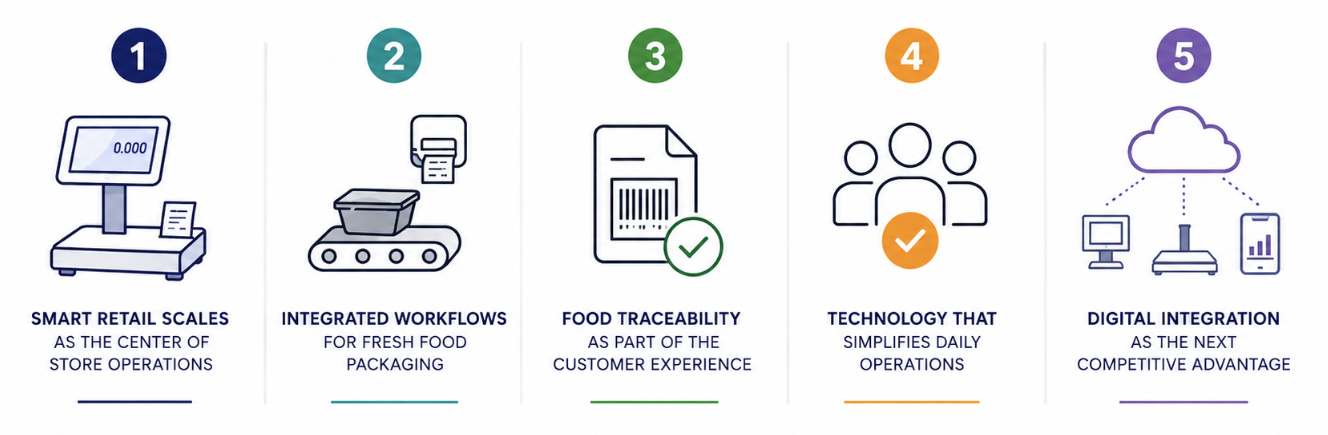
Rather than focusing on a single innovation, we left Fispal with five key observations that we believe will shape the future of fresh food retail across the region.
-
Retail Scales Are Becoming the Center of Store Operations
Perhaps the biggest shift we observed is that retail scales are no longer viewed as standalone weighing devices.
Retailers increasingly expect a scale to do much more than display weight and price. Product information management, barcode generation, label printing, traceability, POS connectivity, and data synchronization are now becoming standard expectations rather than premium features.
As supermarkets continue expanding their fresh food departments, the retail scale is evolving into the center of daily store operations, connecting multiple processes through one intelligent platform.
-
Fresh Food Packaging Is Moving Toward Integrated Workflows
Another clear trend throughout Fispal was the growing demand for simplified packaging operations.
Instead of purchasing independent machines for weighing, wrapping, and labeling, retailers are increasingly looking for solutions that allow these processes to work together seamlessly.
An integrated workflow not only improves operational efficiency but also reduces repetitive manual tasks, shortens staff training time, and helps maintain a consistent product presentation across different fresh food categories.
For supermarkets operating meat, seafood, produce, bakery, and ready-to-eat departments simultaneously, workflow efficiency is becoming just as important as equipment performance.
-
Food Traceability Is Becoming Part of the Customer Experience
Traceability is no longer driven solely by food regulations.
Consumers today want greater transparency about the products they purchase. Country of origin, ingredients, expiration dates, nutritional information, and barcode identification have become important purchasing factors.
This growing expectation means retailers need labeling systems that are accurate, consistent, and easy to manage.
Reliable labeling is no longer simply about compliance—it has become an extension of customer trust.
-
Retailers Are Investing in Technology That Simplifies Daily Operations
One topic repeatedly mentioned during discussions with visitors was labor.
Like many other regions around the world, retailers across Latin America continue facing challenges in recruiting and retaining experienced employees.
Rather than adding more manpower, businesses are increasingly investing in technologies that simplify routine tasks.
Automated weighing, intuitive user interfaces, flexible label management, and streamlined packaging workflows all help reduce operator workload while improving consistency across store operations.
The goal is not simply automation—it is making everyday work easier.
-
Digital Integration Is Becoming the Next Competitive Advantage
Perhaps the most significant takeaway from Fispal 2026 was that retailers are beginning to evaluate equipment differently.
Instead of asking:
"Which retail scale should we buy?"Many are now asking:
"How can our weighing, labeling, packaging, POS, and store management systems work together?"This represents an important shift.
Retail equipment is no longer evaluated as individual machines but as part of an interconnected retail ecosystem.
Businesses that successfully integrate data, equipment, and workflows will likely be better positioned to improve efficiency, reduce operational costs, and respond more quickly to changing consumer demands.
Looking Beyond Fispal
Every exhibition provides a snapshot of where the market is today.
More importantly, it offers a glimpse of where the industry is heading.
For us, Fispal Tecnologia Brazil 2026 reinforced one clear message:
The future of fresh food retail is not defined by faster machines alone. It is shaped by smarter workflows, connected technologies, accurate product information, and solutions that simplify everyday operations for retailers.
As fresh food departments continue expanding and consumer expectations continue rising, retail technology will play an increasingly important role in supporting operational efficiency, food traceability, and a better shopping experience.
Let's Talk About Your Retail Project
At High Dream Retail, we believe retail technology should simplify everyday operations rather than add complexity.
Our retail scales, wrapping machines, and labeling solutions are designed to help supermarkets, fresh food retailers, and food service operators improve packaging efficiency, ensure accurate product information, and build smarter fresh food workflows.
Every retail environment is unique. Whether you're looking to improve in-store weighing, streamline food packaging, or integrate labeling into your retail workflow, our specialists are ready to help.
Contact our team to discuss your application and discover the right retail solution for your business.
Your Business.